
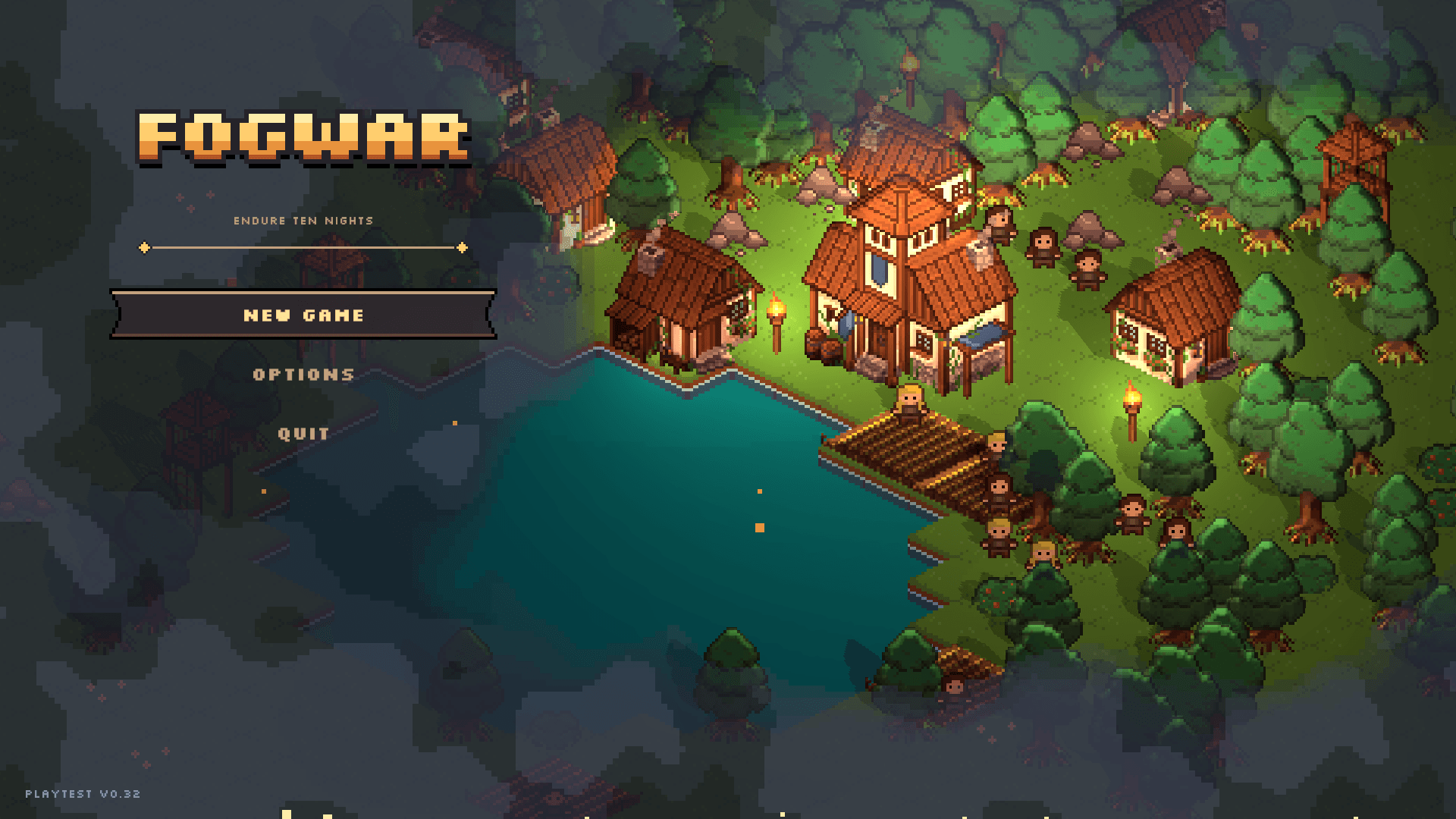
The pitch
FogWar is a 2D isometric survival RTS in pixel art, set in a realistic medieval world with no magic. By day you grow a small village: gathering, building, villagers to feed. By night, raiders come out of the fog for your town hall.
The goal in the current version: hold out until day 11. Raiders strike every night at 10 pm, a few more each time. Scouts warn you at 6 pm, and the raiders flee at dawn.
Inspirations: They Are Billions for the survival, Age of Empires for villagers, resources and ages.
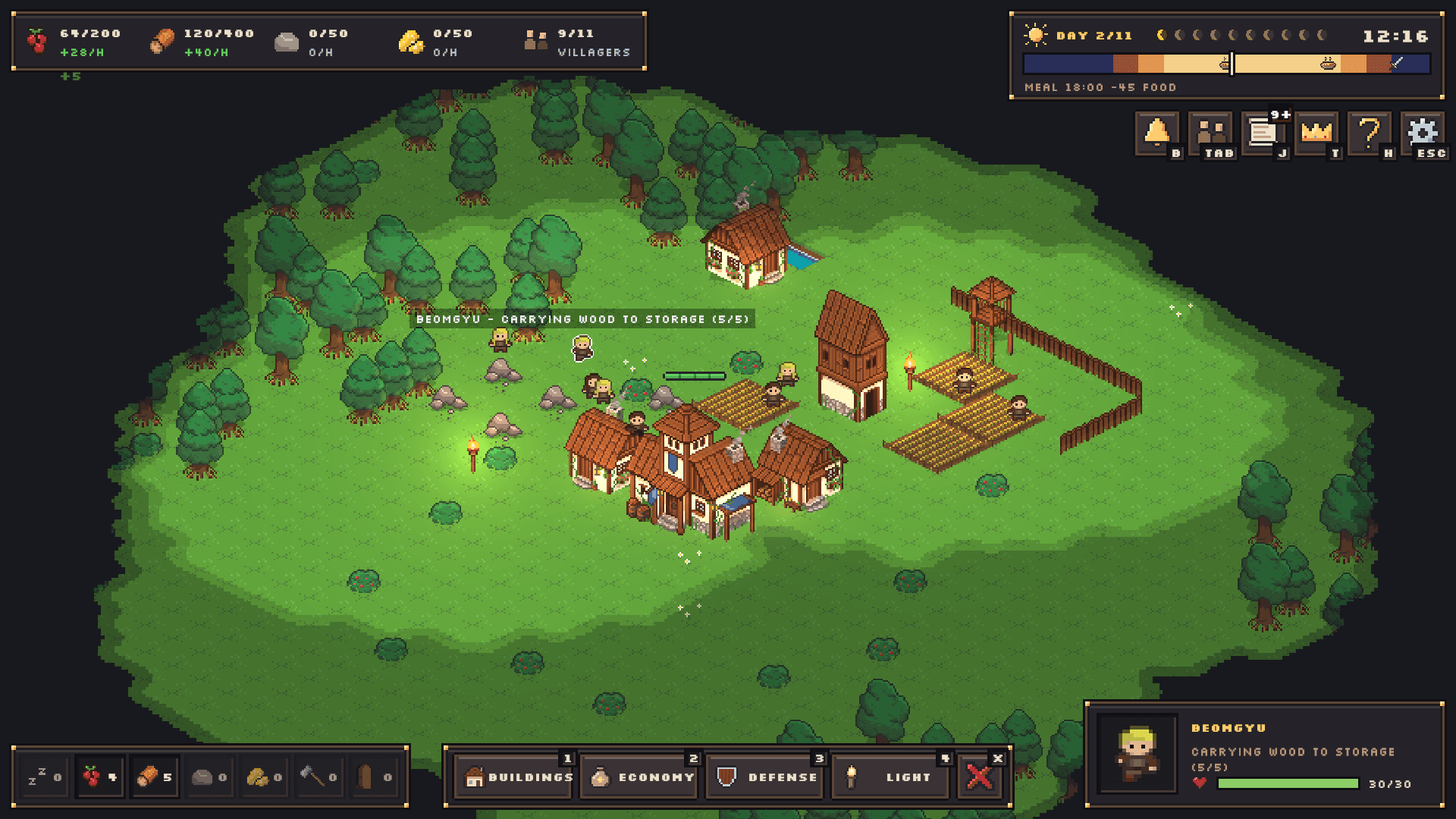
By day: feed the village
Every villager has a name and follows right-click orders: gather from a tree, bush, farm or dock, build a construction site, move. An idle villager goes and helps on a nearby site on their own.
The real pressure is food. Every villager eats at noon and 6 pm. If the stock drops below zero, the whole village works and walks at half speed, training new villagers included.
- berry bushes run out, farms don't, but they have to sit within 4 cells of a windmill;
- a dock, one end on the shore and the other over water, gives endless fish, slower than a farm;
- a new villager is trained at the town hall for food, and needs a free home.
Stone and gold can already be gathered, but they're saved for the ages to come.
By night: fog as a weapon
Vision is the scarcest resource in the game. Out of sight, the map is unknown and raiders are invisible. You can only build where you've already explored.
Every vision source has two radii, day and night, and the actual radius slides between them as the sunlight changes:
A villager sees far by day but barely anything at night, and a building sees nothing unless someone is inside. Torches are the only light that doesn't fade. Rain takes away another quarter of your vision.
To defend, you shelter villagers in the town hall (5 places) or a watchtower (1 place), where they shoot arrows. The alarm bell sends everyone to shelter at once, and the screen edges glow red while raiders are in the village.
A living world, in pixel art
Every sprite is hand-drawn in LibreSprite, on a 32 px per cell base.
 House
 Town hall
 Windmill
 Watchtower
 Farm
Most buildings have a normal map, so 2D lighting (the moving sun, torches, the moon) shades them in relief instead of flat:
Sprite Normal map
Around it, the world moves: a day/night cycle driven by a global light following the sun's arc, trees swaying with a wind shader, cloud shadows, rain made of droplet sprites rather than a particle system, and layered ambient audio (in the rain, the nature ambience drops instead of carrying on at full volume). A campfire's volume even depends on the camera zoom.
A different map every game
The world is 200 × 200 cells, generated from a seed with Perlin noise: water, forests, bushes and stone come in natural clusters rather than scattered at random. A protected zone around the town hall leaves room to build, and if no water is within reach of the start, a pond is dug so a dock is always possible.
The engineering behind it
- Unity 6 and 2D URP, in C#, with independent systems rather than one big central script: grid, cell occupancy, pathfinding, economy, population, weather, fog…
- A* pathfinding on the grid, with a binary-heap priority queue. Buildings span several cells and their footprint follows rotation.
- Over 400 automated tests (EditMode and PlayMode), including an autoplay test: a scripted player plays a full game at high speed to check it can be won with a reasonable strategy, and its daily log is used to tune the balance.
- An engineer's process, even for a game: for each feature (building placement, gathering, population, windmill and farms, villager training and fishing…), a design spec, an implementation plan, then small commits written test-first.