
Connected booths, invisible data
Weinmann Technologies builds connected industrial paint booths. They report data (consumption, statuses, alerts), but customers had no direct access to it: to find out how their equipment was doing, they had to go through after-sales support.
The Client Portal is the answer to that problem, and the subject of my final-year engineering project, completed as a work-study student at Weinmann. I carried it alone, end to end: from defining the need to delivery.
Running the project, not just coding it
Before the first line of code, there was a project to frame. I handled its management entirely:
- gathering requirements from Weinmann's teams and writing them up as a requirements specification;
- organising and planning the work, from breaking it into stages to setting delivery priorities;
- delivering the portal and presenting it at my final-year defence.
Collect
The first technical building block: get each booth's data into a usable database, reliably and securely.
- validation rules right at the PLC, plus handling of transmission errors, so only clean data gets stored;
- an HTTPS link between each PLC and the API, with automatically renewed TLS certificates;
- a Django REST API, authenticated with JWT, dedicated to ingestion: it receives the PLC data and writes it to the database;
- a dedicated MySQL database for the booths: an indexed relational schema, with views and stored procedures to aggregate consumption without slowing the site down.
The real challenge was finding the right pace: data fresh enough to be useful, without flooding the server with requests.
Show
Customers check their booths' status in real time through dashboards: consumption, performance indicators, history and alerts. The goal: a workshop manager understands the situation in a few seconds, without an export or a phone call.
The screens were first mocked up in Figma, then built in Next.js: charts, tables and filters. The portal reads its data through Next.js's built-in API routes, kept separate from the ingestion API.
Screenshot: a booth's dashboard (consumption and alerts)
Separate
A customer portal means many customers on the same platform. The architecture is multi-tenant from the start: each customer has their own access rights and only sees their own equipment.
Authentication has several levels (customer, user, administrator), and each customer manages their own users and administrators, site by site. The role system is designed to grow without a rewrite.
The after-sales back office
On Weinmann's side, the customer service team has its own secure interface:
- creating and editing customers, their sites and their equipment;
- granting and revoking user rights;
- maintenance indicators: connection status, error logs, alerts.
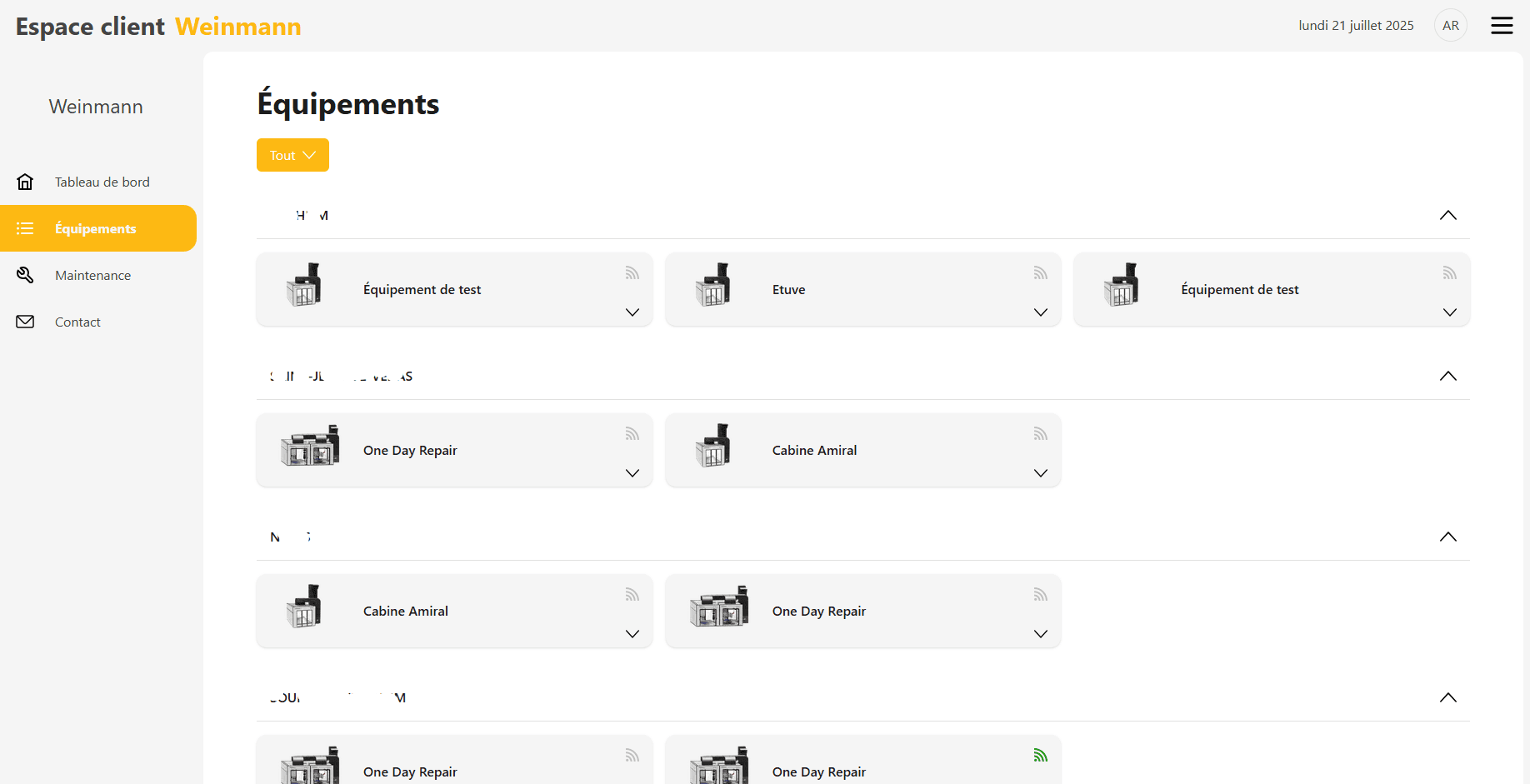
One platform, then, for very different people: an end user, a site manager and an after-sales technician don't need the same screens.
Stack
The portal is built with Next.js and TypeScript with TailwindCSS, and its built-in API routes read the data from MySQL. A Django (Python) API takes care of writing the booth data into it. Everything is hosted on a Linux VPS.